Chiropractic Services
in Ahwatukee
Make it a weekly ritual — relax, recharge, recover.
Services
You book a length of time here, not a treatment. The booking system lists one category – Chiropractic – and a set of timed appointments: 15, 30, 45 and 60 minutes, plus a 60-minute New Patient Examination. Every service on this page is a component that can be used inside one of those appointments. None is separately bookable, separately priced, or billed as its own visit.
That changes how to read what follows. This is not a menu you order from. It is a list of what Dr. Connor Borowski can do with the time you book, and what goes into any given appointment is decided with you at the start of it, based on what the examination shows and what you came in for. A 45-minute appointment might be one adjustment and forty minutes of soft tissue work and corrective exercise. It might be almost entirely one thing.
Chiropractic Care
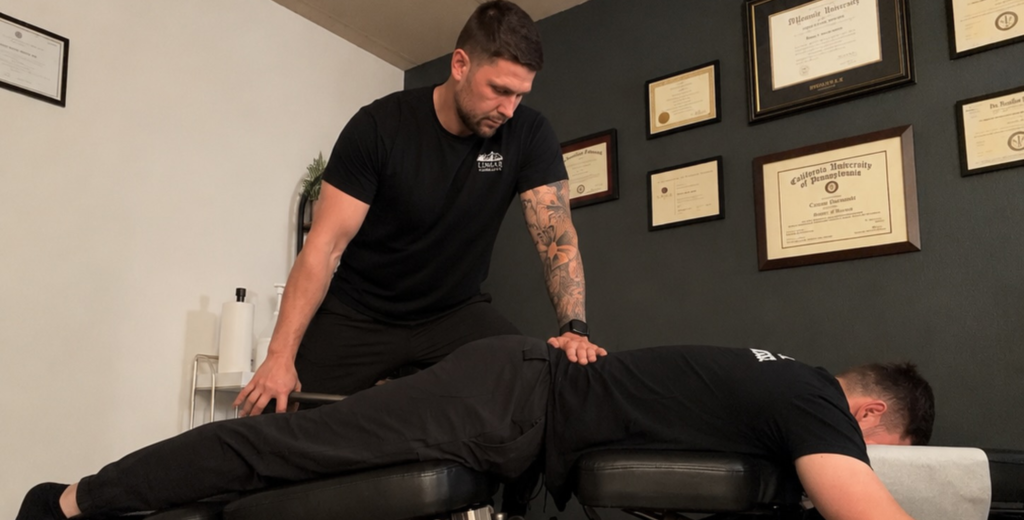
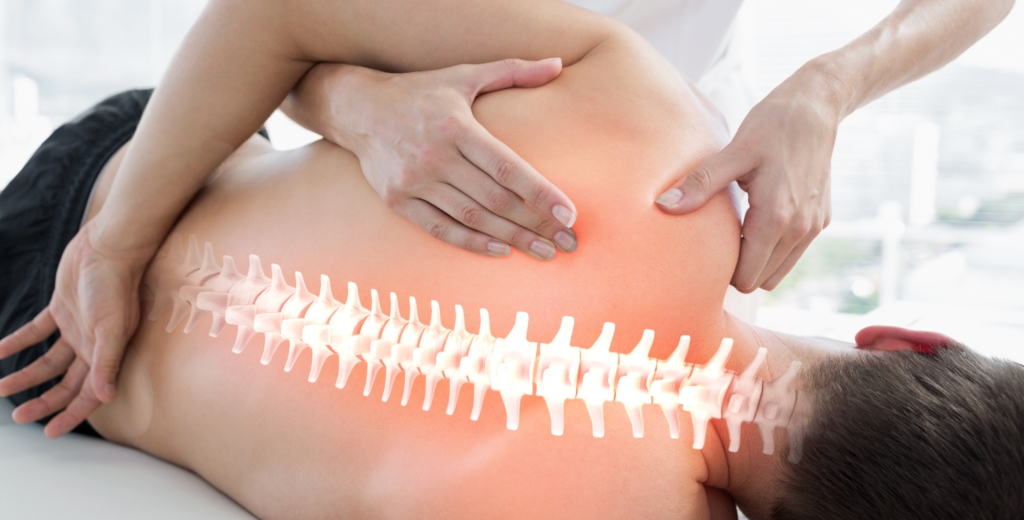
An adjustment is a controlled force applied to a specific joint, usually near the end of its available range. The pop, when there is one, is gas coming out of solution inside the joint capsule. It is not a bone going back into place.
Where that force gets applied is decided by a movement assessment rather than by routine. Dr. Borowski looks at how you hinge, rotate, load and stabilize, and at which segments move too little while the ones next to them move too much. Where a joint is restricted because the muscle around it is guarding, the tissue is addressed first, or instead.
This applies to the spine and to extremities — shoulder, elbow, wrist and hand, hip, knee, ankle and foot.
Rehabilitation & Return-to-Sport
This is loaded, progressive exercise, prescribed and coached inside your appointment. It occupies the stretch between the point where an injury stops being acutely painful and the point where you are back to full training, full shifts or full sport.
The programming comes from work Dr. Borowski did before the clinic: a master’s in exercise science and eight years in collegiate strength and conditioning, four at Division I with St. Bonaventure University. In practice that means exercise written the way a strength coach writes it — a named movement, a load, a set and rep scheme, and a stated criterion for progressing — rather than a generic handout of bands and holds.
Most often used for sports injuries, recurring strains, and the middle phase after disc injuries or rotator cuff problems.

Soft Tissue Work
Soft tissue work is hands-on treatment applied to muscle, tendon and fascia rather than to joints. Pressure is held on a specific area and, in most cases, you move the limb through range while it is held, so the tissue is loaded and lengthened at once.
It appears in most appointments for a mechanical reason. A joint that will not move often has tissue around it that has shortened, thickened or become sensitive to load. Treating the joint alone tends to leave that restriction in place.
Regions worked most often: neck and upper back for neck pain, stiffness, headaches and migraines; glutes and hip rotators for low back pain and sciatica; forearm for elbow, wrist and hand pain; calf and plantar tissue for ankle and foot pain.
Cupping
Cups are placed on the skin and air is drawn out of them with a hand pump. The negative pressure lifts the skin and the tissue underneath into the cup. That is the opposite direction of force from every other hands-on component on this page, all of which press down.
Cups may be left in place for a few minutes while you hold a position, or moved across an oiled region while suction is maintained. Circular marks are an expected effect of the negative pressure rather than a sign of injury; how long they take to fade varies.
Most often applied over the upper back and shoulders, the lower back, the quadriceps and hamstrings, and the calves – usually a few minutes within a longer appointment.
IASTM
IASTM is instrument-assisted soft tissue mobilization. A beveled tool, typically stainless steel, is drawn across the skin over a specific region while the tissue underneath is held on tension or moved through range.
The instrument does two things a thumb cannot. It concentrates force into a narrow edge, so pressure can be directed at a small area rather than spread across a hand. And it transmits vibration back to the clinician, used to locate the specific area being treated within a broader region.
Applied most often over tendon-related complaints at the elbow, knee, ankle and foot, over the plantar surface, and over regions of scar tissue. No separate page, no separate booking.
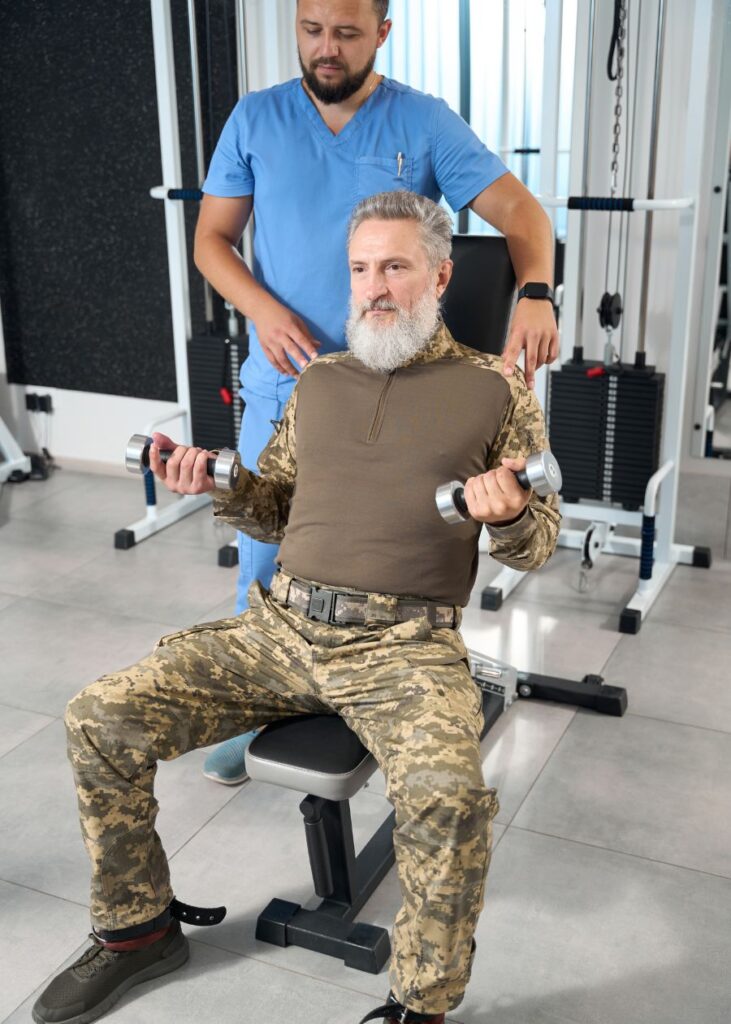
Strength Training
Strength training inside a chiropractic appointment is not a workout. It is the portion of the visit where you are taught to produce and control force in the positions that failed during the assessment.
A session covers a few movements – a hinge, a squat pattern, a carry, a press or a pull. Each is cued, corrected while you do it, then written down with its load and rep scheme so it can be repeated between visits. Resistance is real resistance: dumbbells, bands, cables, weighted carries, graded bodyweight progressions.
This component is used where the limiting factor looks like capacity rather than irritability – postural dysfunction, chronic pain, knee and hip complaints, and injuries that recur in the same place under the same loads.
Mobility Training
Mobility is range you can control. Flexibility is range you can be put into. The distinction matters, because a joint that passively reaches a position it cannot hold under its own tension is left to the muscles around it to protect.
So the work here is active. You are taken to the end of an available range and asked to produce tension there – isometric holds, controlled rotations through the outer edge of a joint’s range, positions loaded lightly rather than stretched passively. Between visits it becomes a short daily sequence, not a stretching routine.
Used for mobility restrictions, postural dysfunction, and the guarded stiffness that follows disc injuries, shoulder problems or long stretches at a desk. It is also the component most often paired with an adjustment in a 30-minute appointment.
Dry Needling & Electrical Stimulation
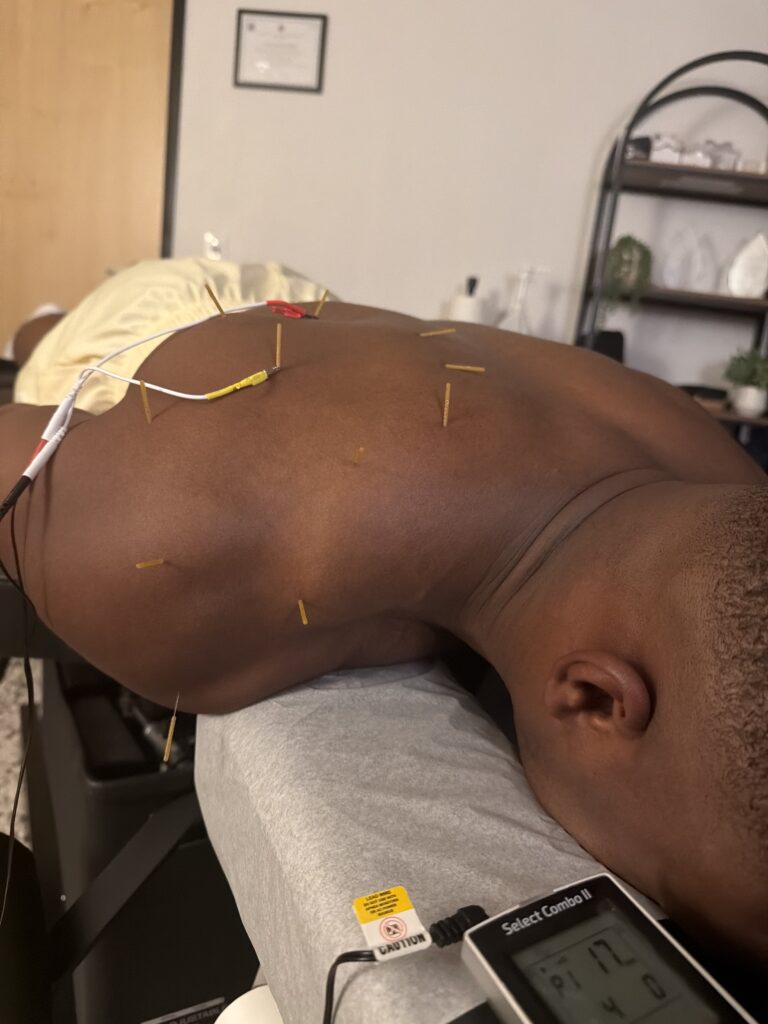
A thin filiform needle – the same class of needle used in acupuncture, though the reasoning behind placement is different – is inserted through the skin into a taut band within a muscle. Nothing is injected. The needle is placed by palpation, and insertion sometimes produces a brief involuntary twitch, a deep ache, or a heavy sensation that settles within seconds.
Electrical stimulation may be run through the needles, or applied separately with surface electrodes on the skin. A low current is passed through the tissue at an intensity set to what you can tolerate; you feel a tapping or buzzing.
Commonly used for neck and shoulder pain, headaches and migraines with a muscular component, gluteal and hip pain, and forearm tissue in elbow complaints.
Spinal Decompression
Spinal decompression is mechanical traction delivered by a motorized table. You lie down, harnessed at the pelvis and trunk, and the table applies a pull along the long axis of the spine. The pull is cycled – building to a set tension, holding, easing off, repeating – rather than applied as one constant force, because a sustained pull tends to be met by the muscles guarding against it.
The mechanical rationale is straightforward: separating adjacent vertebrae reduces compressive load across the disc and the space the nerve root exits through, for the duration of the pull.
Used for disc injuries, sciatica and nerve pain, and some presentations of low back and neck pain. Decompression consumes clock time, so an appointment including it has less room for other components.
Choosing an Appointment Length
Every new patient starts with the New Patient Examination – 60 minutes, $145. That covers history, physical and movement examination, and treatment within the same visit where appropriate.
After that you choose a length:
15 minutes - $65
A focused adjustment, a progress check or maintenance. Established patients only.
30 minutes - $105
Assessment, hands-on treatment, chiropractic care, mobility work, and a discussion of where things stand.
45 minutes - $150
The clinic’s most common option. Extended one-on-one work on complex issues, chronic pain, recurring injury and movement dysfunction: deeper assessment, treatment, corrective exercise, soft tissue work and planning.
60 minutes - $190
Full evaluation, chiropractic care, soft tissue therapy, mobility and corrective work, rehabilitation strategy and goal-setting. Used most by athletes and active patients.
Four-packs: 15 minutes $199 (saves $61) · 30 minutes $349 (saves $71) · 45 minutes $499 (saves $101) · 60 minutes $629 (saves $131).
What actually fits. Fifteen minutes is one component on a region already examined – an adjustment, or a short round of needling. Thirty fits an adjustment plus one other thing, usually mobility work or focused soft tissue work. Forty-five is the first length where deeper assessment, soft tissue work and coached corrective exercise all fit in one visit without any being cut short, which is why most people book it. Sixty is for when several slow components are in play at once – decompression, needling and loaded rehabilitation each occupy the clock.
Lumara is cash-pay and out-of-network by choice.